Chapter 1: All Is Vanity
The Preacher States His Case

Chapter 1 is the overture of Ecclesiastes. In eighteen verses the Preacher announces his theme, describes the endless cycles of nature and history, and introduces himself as a king who set out to search out everything done under heaven. By the end of the chapter he has already reached a sobering verdict: the crooked cannot be made straight, and more wisdom brings more grief. The rest of the book unfolds and tests that verdict.
The Preacher Introduced
Ecclesiastes 1:1 (ASV)
1 The words of the Preacher, the son of David, king in Jerusalem.
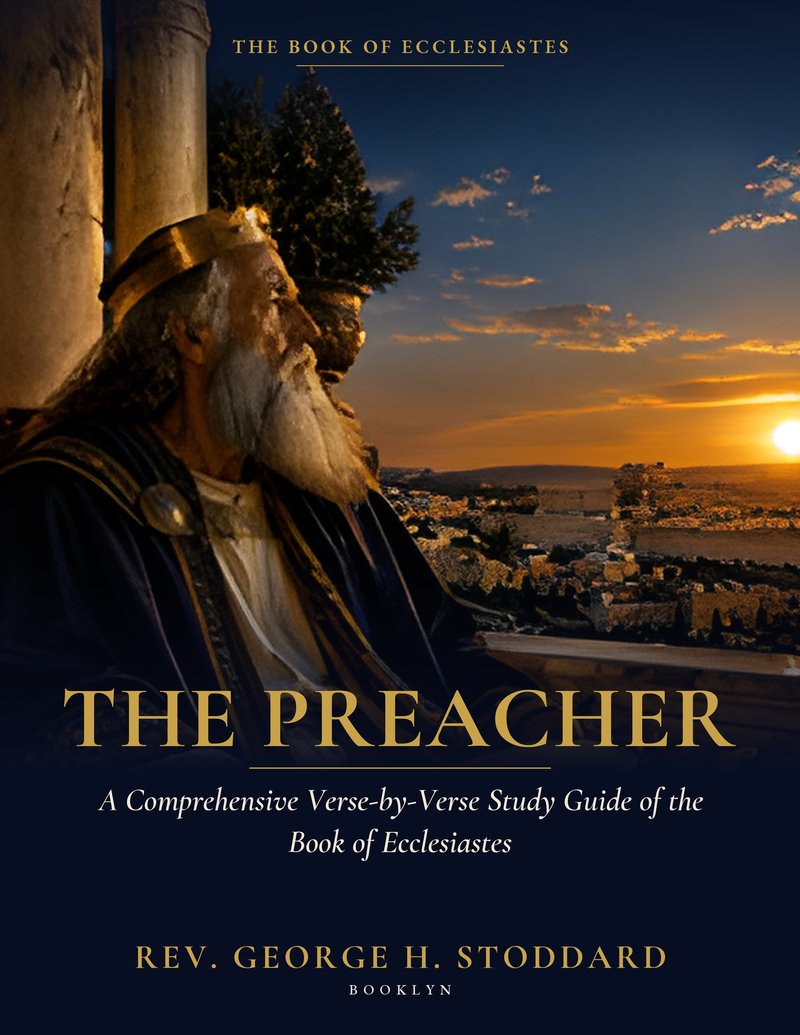
v. 1 — The book opens with the speaker's credentials. He is "the Preacher," Qoheleth, the one who gathers an assembly to hear him. He is "the son of David," which identifies him with the royal line God promised to establish forever (2 Samuel 7:12-16). And he is "king in Jerusalem," the city God chose to put His name there (1 Kings 11:36). This is no armchair philosopher. He is a man with unlimited resources, unrivaled wisdom and absolute authority, the one person in the ancient world best positioned to test whether anything under the sun can satisfy the human heart.
The title "Preacher" also tells us how to read the book. This is not a private diary; it is a message addressed to a congregation. Qoheleth wants us to listen, to think and ultimately to respond. Like a preacher, he will argue, illustrate, warn and plead, and he will close with an altar call: "Fear God, and keep his commandments" (12:13).
The Thesis: Vapor of Vapors
Ecclesiastes 1:2-3 (ASV)
2 Vanity of vanities, saith the Preacher; vanity of vanities, all is vanity.
3 What profit hath man of all his labor wherein he laboreth under the sun?
v. 2 — "Vanity of vanities" is a Hebrew superlative, like "song of songs" or "holy of holies." It means "the most fleeting of all fleeting things," "utter vapor." The Preacher repeats the phrase twice and then sweeps it over everything: "all is vanity." The Hebrew hebel is the word for breath or mist. It is also the name of Abel (Hebel), the second son of Adam, whose life was cut short like a breath (Genesis 4:8). Under the sun, every life, every achievement and every pleasure is like Abel: here, and then suddenly gone.
v. 3 — The question of verse 3 drives the whole book: "What profit hath man of all his labor wherein he laboreth under the sun?" The word "profit" (yithron) is a business term meaning what is left over, the surplus or net gain. After all the effort, sweat and planning of a lifetime, what is left in the account when the books are closed? Notice the qualifier "under the sun." The Preacher is not asking whether labor done for God has value; Paul assures us it does (1 Corinthians 15:58). He is asking whether labor viewed only on the earthly level produces any permanent gain. Jesus asked the same question: "What shall a man be profited, if he shall gain the whole world, and forfeit his life?" (Matthew 16:26).
The Endless Cycles of Creation
Ecclesiastes 1:4-7 (ASV)
4 One generation goeth, and another generation cometh; but the earth abideth for ever.
5 The sun also ariseth, and the sun goeth down, and hasteth to its place where it ariseth.
6 The wind goeth toward the south, and turneth about unto the north; it turneth about continually in its course, and the wind returneth again to its circuits.
7 All the rivers run into the sea, yet the sea is not full; unto the place whither the rivers go, thither they go again.
v. 4 — Generations rise and fall like waves, "but the earth abideth for ever." The irony is sharp: man, made in God's image and given dominion over the earth, passes away, while the dirt he walks on remains. Each of us is a temporary resident on a permanent stage.
v. 5 — The sun rises, sets and "hasteth" (literally "pants") back to its place, like a runner gasping as it hurries to start the same race again. Psalm 19:5 pictures the sun as a joyful strong man running his course; the Preacher sees the same sun as a weary laborer on an endless treadmill.
v. 6 — The wind blows south, turns north, and goes round and round, "and the wind returneth again to its circuits." Motion without arrival. It is a striking description of atmospheric circulation, written centuries before modern meteorology, and it fits the Preacher's point perfectly: endless activity, no final destination.
v. 7 — "All the rivers run into the sea, yet the sea is not full." The water returns to the place from which it came, through evaporation and rain (compare Job 36:27-28; Amos 9:6), and the cycle begins again. Nature is busy, but nature never finishes. The Preacher's point is not to criticize creation but to show that if we look to the created order for meaning, we find repetition rather than resolution. Romans 8:20 explains why: "the creation was subjected to vanity," waiting for the day of redemption.
Nothing New Under the Sun
Ecclesiastes 1:8-11 (ASV)
8 All things are full of weariness; man cannot utter it: the eye is not satisfied with seeing, nor the ear filled with hearing.
9 That which hath been is that which shall be; and that which hath been done is that which shall be done: and there is no new thing under the sun.
10 Is there a thing whereof it may be said, See, this is new? it hath been long ago, in the ages which were before us.
11 There is no remembrance of the former generations; neither shall there be any remembrance of the latter generations that are to come, among those that shall come after.
v. 8 — "All things are full of weariness." The cycles of nature are mirrored in the human heart. "The eye is not satisfied with seeing, nor the ear filled with hearing." We are made with appetites that the world can stimulate but never fill. Proverbs 27:20 says the same: "the eyes of man are never satisfied." That restless hunger is not a design flaw; it is a homing signal pointing beyond the world to God (see 3:11).
v. 9 — "There is no new thing under the sun." Technology changes, but human nature, human sin and human longing do not. The same pride that built Babel builds empires today; the same greed, lust, fear and hope fill every generation. Solomon is not denying invention; he is denying that any invention can change the fundamental condition of life under the sun.
v. 10 — When people do claim, "See, this is new," the Preacher answers that "it hath been long ago, in the ages which were before us." What seems novel is usually a rediscovery or a rearrangement of something old.
v. 11 — Then the most humbling verse of the chapter: "There is no remembrance of the former generations." Most people who have ever lived are utterly forgotten, and we will be too. Fame is vapor. Only God keeps a perfect remembrance: "a book of remembrance was written before him, for them that feared Jehovah" (Malachi 3:16).
The King's Great Search
Ecclesiastes 1:12-15 (ASV)
12 I the Preacher was king over Israel in Jerusalem.
13 And I applied my heart to seek and to search out by wisdom concerning all that is done under heaven: it is a sore travail that God hath given to the sons of men to be exercised therewith.
14 I have seen all the works that are done under the sun; and, behold, all is vanity and a striving after wind.
15 That which is crooked cannot be made straight; and that which is wanting cannot be numbered.
v. 12 — The Preacher now speaks in the first person: "I the Preacher was king over Israel in Jerusalem." The past tense "was" may reflect a man writing late in life, looking back over his reign.
v. 13 — He "applied [his] heart to seek and to search out by wisdom concerning all that is done under heaven." This was a deliberate, systematic investigation, the most thorough research project ever undertaken by a human being. His first finding is that the search itself is "sore travail," a heavy burden "that God hath given to the sons of men to be exercised therewith." God has built into human beings a drive to understand, but under the curse (Genesis 3:17-19) that drive is accompanied by frustration.
v. 14 — "I have seen all the works that are done under the sun; and, behold, all is vanity and a striving after wind." To strive after wind is to try to catch, herd or grasp something that by its very nature cannot be held. That is life under the sun.
v. 15 — "That which is crooked cannot be made straight; and that which is wanting cannot be numbered." Human wisdom cannot fix what sin has bent, and it cannot supply what is missing. Only God can make the crooked straight (Isaiah 40:4; Luke 3:5), and the Preacher will later say that no one can straighten what God has made crooked (7:13). This is a confession of the limits of human ability, and it prepares the heart for grace.
The Burden of Wisdom
Ecclesiastes 1:16-18 (ASV)
16 I communed with mine own heart, saying, Lo, I have gotten me great wisdom above all that were before me in Jerusalem; yea, my heart hath had great experience of wisdom and knowledge.
17 And I applied my heart to know wisdom, and to know madness and folly: I perceived that this also was a striving after wind.
18 For in much wisdom is much grief; and he that increaseth knowledge increaseth sorrow.
v. 16 — Solomon "communed with [his] own heart." He reviewed his credentials: he had gotten great wisdom "above all that were before me in Jerusalem," and his heart "hath had great experience of wisdom and knowledge." God Himself had promised that no one before or after would be like him in wisdom (1 Kings 3:12). If wisdom alone could deliver lasting satisfaction, this man would have found it.
v. 17 — He studied both sides: wisdom, and "madness and folly." He wanted to understand life from every angle, including the lives of fools. His conclusion: "this also was a striving after wind."
v. 18 — "For in much wisdom is much grief; and he that increaseth knowledge increaseth sorrow." The more clearly you see the world, the more clearly you see its injustice, brokenness and death. Ignorance can be a kind of anesthesia; wisdom removes it. This is not an argument against learning; Proverbs commands us to get wisdom (Proverbs 4:7). It is a warning that wisdom detached from God cannot heal what it reveals. The cure for the sorrow of knowledge is not less knowledge but the knowledge of God, "in whom are all the treasures of wisdom and knowledge hidden" (Colossians 2:3).